
As I delve deeper into the realm of Artificial Intelligence (AI), I find myself navigating a complex landscape filled with varying definitions and classifications. The AI community is rife with confusions and disagreements about what AI truly encompasses and how it should be categorized. This lack of consensus can be both intriguing and overwhelming for those trying to grasp the breadth and depth of AI technologies.
One area where disagreements are particularly pronounced is in the types and stages of AI classifications. Beyond the debate on the very definition of AI, there is a multitude of ways to classify AI technologies, each offering a different lens through which to view this rapidly evolving field.
In this article, I aim to define AI in a way that captures its multifaceted nature and explore the different ways we might classify this ever-expanding domain. By shedding light on these classifications—including predictive AI and generative AI—I hope to provide clarity and a foundational understanding for fellow enthusiasts and leaders interested in AI’s potential and implications.
Defining Artificial Intelligence
At its core, Artificial Intelligence refers to the simulation of human intelligence processes by machines, especially computer systems. These processes include learning (the acquisition of information and rules for using the information), reasoning (using rules to reach approximate or definite conclusions), perception, language understanding, and self-correction.
However, even this definition is subject to interpretation. Some experts argue that AI should only refer to systems that can perform tasks requiring human intelligence, while others include any system that mimics cognitive functions, regardless of how it achieves this mimicry.
To navigate this ambiguity, it’s helpful to consider AI as a spectrum of technologies and methodologies aimed at enabling machines to perform tasks that would typically require human intelligence. This encompasses a wide range of applications, from simple rule-based systems to complex algorithms capable of learning and adapting.
Exploring the Multiple Classifications of AI
Given the diverse definitions of AI, it’s no surprise that numerous ways to classify it have emerged. These classifications often overlap and intersect, reflecting the field’s complexity, the varied approaches to AI development, and its rapid evolution. Overlapping categories like predictive AI and generative AI illustrate how AI continues to expand into new domains, necessitating ongoing updates to classification systems. For leaders and innovators, understanding these classifications is essential for informed decision-making, addressing ethical considerations, and strategically implementing AI technologies.
1. Classification Based on Capabilities and Levels of Intelligence
This classification looks at AI in terms of its ability to replicate human cognitive functions and its level of sophistication.
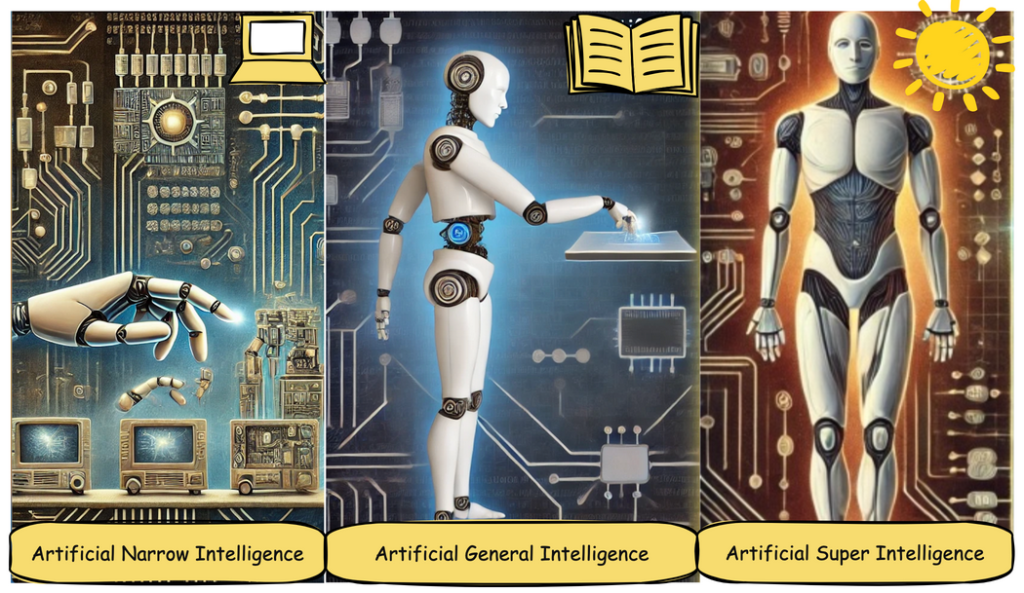
Artificial Narrow Intelligence (ANI) – Weak AI: ANI systems are designed to perform specific tasks without possessing consciousness or self-awareness. They excel in their designated functions but cannot operate beyond their programmed capabilities. Examples are voice assistants like Siri or Alexa, recommendation algorithms on Netflix or Amazon, and chatbots for customer service.
Artificial General Intelligence (AGI) – Strong AI: AGI refers to systems that possess the ability to understand, learn, and apply knowledge in a way that is indistinguishable from human intelligence. AGI can perform any intellectual task that a human being can. As of now, AGI remains a theoretical concept, with researchers striving to achieve this level of sophistication.
Artificial Super Intelligence (ASI): ASI goes beyond AGI, representing AI that surpasses human intelligence in all aspects, including creativity, general wisdom, and problem-solving. ASI remains speculative and is the subject of philosophical and ethical debates concerning its potential impact on humanity.
2. Classification Based on Functionalities
Reactive Machines: These are the most basic AI systems that perceive the world directly and act on what they see. They do not form memories or use past experiences. IBM’s Deep Blue, the chess-playing computer that defeated Garry Kasparov.
Limited Memory: AI systems that use past experiences to inform future decisions fall into this category. Most current AI applications rely on limited memory AI to make real-time decisions based on historical data. Self-driving cars that analyze recent data like speed and direction of other vehicles.
Theory of Mind: This type of AI is still in the research phase and involves systems that can understand emotions, beliefs, and thought processes of other entities. This could revolutionize human-computer interactions by enabling machines to comprehend and respond to human emotions more effectively.
Self-Aware AI: Representing the most advanced form of AI, self-aware systems possess consciousness and self-awareness similar to human beings. This is purely hypothetical and raises profound ethical and philosophical questions.
3. Classification Based on Techniques and Technologies
Machine Learning (ML): A subset of AI that enables systems to learn from data and improve over time without explicit programming. Subcategories are –
- Supervised Learning: Learning from labeled datasets.
- Unsupervised Learning: Identifying patterns in unlabeled data.
- Reinforcement Learning: Learning optimal actions through rewards and penalties.
Deep Learning: An advanced subset of ML involving neural networks with multiple layers, capable of modeling complex patterns in data. We can apply this in Image and speech recognition, natural language processing.
Natural Language Processing (NLP): Enables machines to understand and interpret human language. Examples are language translation services, virtual assistants, sentiment analysis.
Computer Vision: Allows machines to interpret and process visual data from the world. We can apply this to facial recognition systems, autonomous vehicles, medical imaging analysis.
Expert Systems: AI programs that emulate the decision-making ability of a human expert. Fields include finance, medicine, engineering.
Predictive Analytics (Predictive AI): Uses historical data, statistical algorithms, and machine learning techniques to predict future outcomes. We can apply this to financial forecasting, risk assessment, customer behavior analysis and many more.
Generative AI: Focuses on creating new content by learning patterns from existing data. Relevant technologies include Generative Adversarial Networks (GANs), transformer models like GPT-4. You can apply this to deepfake technology, content creation, style transfer in images, music, and text generation, amongst others.
4. Classification Based on Applications and Domains
Healthcare AI: Transforming the medical field with diagnostic systems, personalized medicine, robotic surgery, and drug discovery.
Finance AI: Enhancing fraud detection, algorithmic trading, credit scoring, and risk assessment.
Manufacturing AI: Revolutionizing production through robotics, predictive maintenance, supply chain optimization, and quality control.
Transportation AI: Developing autonomous vehicles, optimizing traffic management systems, and enhancing logistics.
Entertainment AI: Utilizing generative AI to create music, art, and virtual environments, personalizing content recommendations.
5. Classification Based on Generations or Evolution
First Generation – Rule-Based Systems: AI systems that follow predefined rules and logic.
Second Generation – Context Awareness and Retention: Systems using historical data and context for decision-making.
Third Generation – Domain-Specific Knowledge: AI demonstrating expertise in particular fields.
Fourth Generation – Reasoning Systems: Capable of making judgments under uncertainty.
Fifth Generation – Self-Aware Systems: Hypothetical AI with consciousness and self-awareness.
6. Classification Based on Philosophical Concepts
Symbolic AI (Good Old-Fashioned AI): Based on manipulating high-level, human-readable symbols.
Connectionist AI: Utilizes neural networks and parallel processing.
Behavioral AI: Focuses on observable behaviors and actions.
7. Classification Based on Ethical and Social Implications
Transparent AI: Systems with explainable and transparent decision-making processes.
Black-Box AI: AI systems with internal workings not easily understood.
Ethical AI: Emphasizes the development of AI systems that align with moral values and societal norms.
8. Classification Based on Deployment Models
Cloud AI: AI services provided over the internet.
Edge AI: AI computations performed on local devices at the network’s edge.
Hybrid AI: Combines cloud and edge computing.
9. Classification Based on Learning Methodologies
Transfer Learning: Applying knowledge from one task to a related task.
Meta-Learning: AI that improves its learning algorithms over time.
Federated Learning: Training models across decentralized devices without exchanging data.
Generative Models (Generative AI): Learning data distributions to generate new data.
Conclusion
Artificial Intelligence is a multifaceted field with no singularly agreed-upon definition or classification system. By exploring the various ways AI can be classified—including predictive AI, generative AI, and beyond—we gain a comprehensive understanding of the field’s complexities.
As we navigate this landscape, remaining open to new perspectives ensures that we not only keep pace with technological advancements but also shape them ethically and beneficially for society.

 Leader's Whiteboard