
We have all had those weeks. You attend every meeting, clear your Jira board, and ship code every single day. You are exhausted by Friday, yet you have a nagging feeling: Did I actually move the needle? I recently shared a document with my team regarding a critical mindset shift that separates “being busy” from “creating value.” It comes down to the distinction between Output and Outcome. While we often measure our days by what we produce, the business measures our success by the change we create.
The Core Distinction
To level up your career, you must understand the difference between the “what” and the “why.”
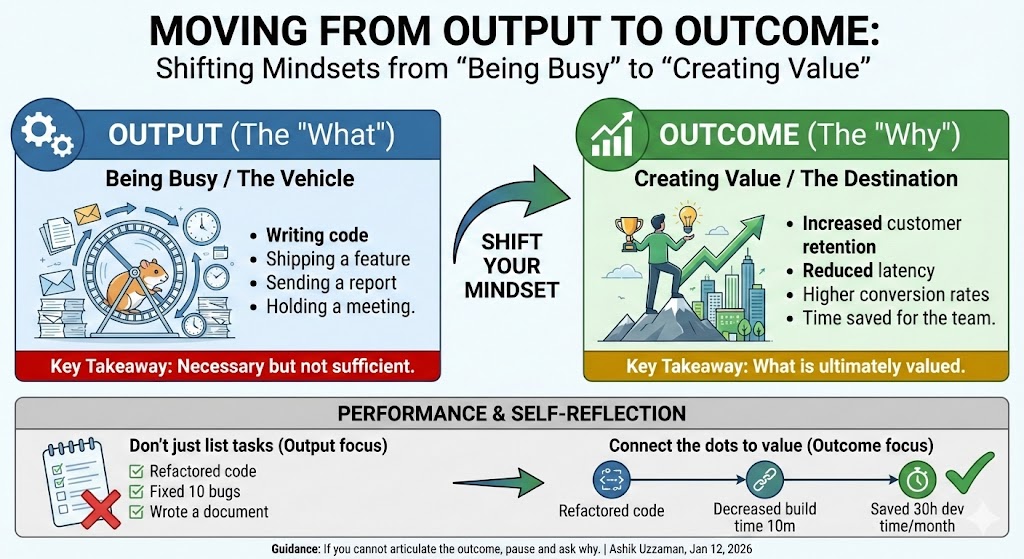
- Output (The Vehicle): These are the deliverables. Writing code, sending reports, holding meetings. Output is necessary, but it is not sufficient.
- Outcome (The Destination): This is the change that occurs because of your output. Did you increase retention? Did you reduce latency? Did you save the team time?
The hard truth: Senior Leadership doesn’t pay for the code you write; they pay for the value that code generates.
The Resume & Review Trap
The most common mistake I see in performance reviews and self-reflections is a laundry list of tasks. Listing outputs proves you worked hard, but it doesn’t prove you generated value. When writing your self-reflection, you need to connect the dots. Here is how to reframe your narrative from Output to Outcome:
| Instead of saying (Output Focus)… | Say this (Outcome Focus)… |
| “I refactored the legacy code base.” | “I refactored legacy code, which decreased build times by 10 minutes, saving the team 30 hours of dev time monthly.” |
| “I fixed 10 bugs in the backlog.” | “I resolved 10 high-priority bugs, which increased stability and contributed to 15% fewer support tickets in Q4.” |
| “I wrote a doc on how the screening tool works.” | “I established the source-of-truth documentation for screening. This drastically reduced ad-hoc questions in public channels and accelerated new engineer onboarding.” |
| “I delivered the new workflow feature.” | “Delivered the workflow to resolve a critical under-reporting gap. This solution was decisive in securing the contract renewal for our largest customer.” |
Guidance: If you cannot articulate the outcome of your work, pause and ask yourself why you are doing it.
What if the Outcome is Unclear?
Sometimes, a ticket lands on your board that looks like pure Output (e.g., “Build this widget”) without a clear link to value. Don’t just start coding. Use this protocol:
- Clarify the Ask: Go to your PM or EM. Ask: “What specific problem is this solving?” and “How will we measure success?”
- Propose a Hypothesis: If no metric exists, take ownership. Propose one. “I propose we track click-through rates. If it exceeds 5%, we consider it a success.”
- The Pivot: If you discover we are building features without criteria, identifying that gap is the outcome. You have shifted from “shipping a feature” to “identifying a blind spot in product strategy.”
The “Absence Test”
How do you measure your intangible value, specifically your leadership and influence? I encourage my team to use the Long PTO Test. Imagine you are away for two weeks. How does the team handle momentum in your absence?
- Low Value: The team continues exactly as is. (This suggests your strategic influence might be low).
- Negative Dependency: The team collapses because you hoard information. (This is a failure of delegation, not a sign of value).
- High Value (True Outcome): The team keeps running (operational excellence), but they miss your insight, strategic direction, and problem-solving capability.
Your goal is to build systems that survive your absence (Output), but provide leadership that is missed when you are gone (Outcome).
Moving from Execution to Strategy
If you feel you are stuck in “Execution mode,” you can shift to Strategy by changing how you handle your work:
- Don’t just solve the ticket; solve the pattern. Fixing a bug is output. Writing a linter rule that prevents that class of bugs forever is a strategic outcome.
- Don’t just answer questions; document the answers. Answering a DM helps one person. Creating a “How-To” guide that onboards the next 10 engineers helps the organization.
- Don’t wait for requirements; clarify ambiguity. Leadership values those who create clarity from chaos.
The next time you sit down to plan your week or write your review, look at your list. Are you just “doing things,” or are you changing things? Stop Confusing Motion with Progress.
Can you share a recent example where you felt you produced a lot of output, but the outcome wasn’t clear? How did you handle it?

 Leader's Whiteboard