
A few weeks ago, I started something deliberately low-tech at Checkr: a bi-weekly “connection hour.” One topic, one hour, no prep required, no sprint work talk. The idea came out of a candid conversation about how AI is quietly increasing everyone’s cognitive load — more output, more review, more context-switching. I wanted an hour that pulled people out of the grind and back into actual human conversation.
For our first session, we picked Patrick Lencioni’s The Ideal Team Player. It’s a book many of us had read years ago, and its model is famously simple: the best teammates share three overlapping virtues — they are humble, hungry, and smart.
What made the discussion interesting wasn’t the model itself. It was the question we kept circling back to: does this framework, written a decade ago, still describe the ideal team player in 2026 — when nearly everyone works alongside AI?
The model, briefly
For anyone who hasn’t read the book: humble isn’t thinking less of yourself, it’s thinking about yourself less — putting the team’s success ahead of your own credit. Hungry is the internal drive to do more and go beyond what’s asked, without being told; Lencioni argues it’s the hardest to coach, and recommends screening for it first in interviews. Smart isn’t IQ or technical skill — it’s people-smarts, knowing how your words and actions land on others.
The power of the model is in the overlaps. Someone humble and hungry but not smart is an “accidental mess maker” — well-meaning, hardworking, and constantly stepping on toes. Humble and smart but not hungry gives you the “lovable slacker.” And the most dangerous profile is hungry and smart but not humble: the “skillful politician,” who is people-smart enough to mask the missing humility for a long time. By the time the damage is visible, a lot of it has already accumulated.
What AI changes
Here’s where our conversation got interesting. Each attribute, we found, means something different when AI is part of every workflow.
Humble matters more than ever. AI makes it dramatically easier to produce work — and dramatically easier to ship work you don’t fully understand or stand behind. When generating output is cheap, accountability becomes the scarce resource. Humility in the AI era means owning what you ship, admitting when you leaned on a tool you didn’t verify, and caring more that the team gets it right than that you look prolific. Ironically, the environments where humility has always been hardest to maintain — technical, expertise-driven ones — are exactly where it’s now most needed.
Smart shifts from reading the room to reading the machine. Lencioni meant emotional intelligence, and that still matters. But a new kind of judgment is joining it: knowing when to trust AI, when to question it, and how to evaluate its output. Call it critical thinking, call it wisdom — the teammate who accepts every confident-sounding answer at face value creates a new kind of team risk that didn’t exist when the book was written.
Hungry gets easier — and shallower. This was the most counterintuitive takeaway. AI lowers the barrier to curiosity and output so much that hunger is now easier to fake, or to sustain only superficially. Anyone can generate ten prototypes over a weekend. The question is whether the drive goes deeper than the demo: does this person push through the hard, unglamorous parts that AI can’t do for them? Hunger used to be visible in volume of effort. Now volume is cheap, and the real signal has moved.
A fourth attribute?
Toward the end of the session, I proposed adding a fourth circle to the Venn diagram: adaptiveness. The tools and expectations of our work shift dramatically every five to ten years — and the current shift feels faster than any before it. The best teammates aren’t just humble, hungry, and smart within today’s toolset; they reinvent how they work when the toolset changes underneath them.
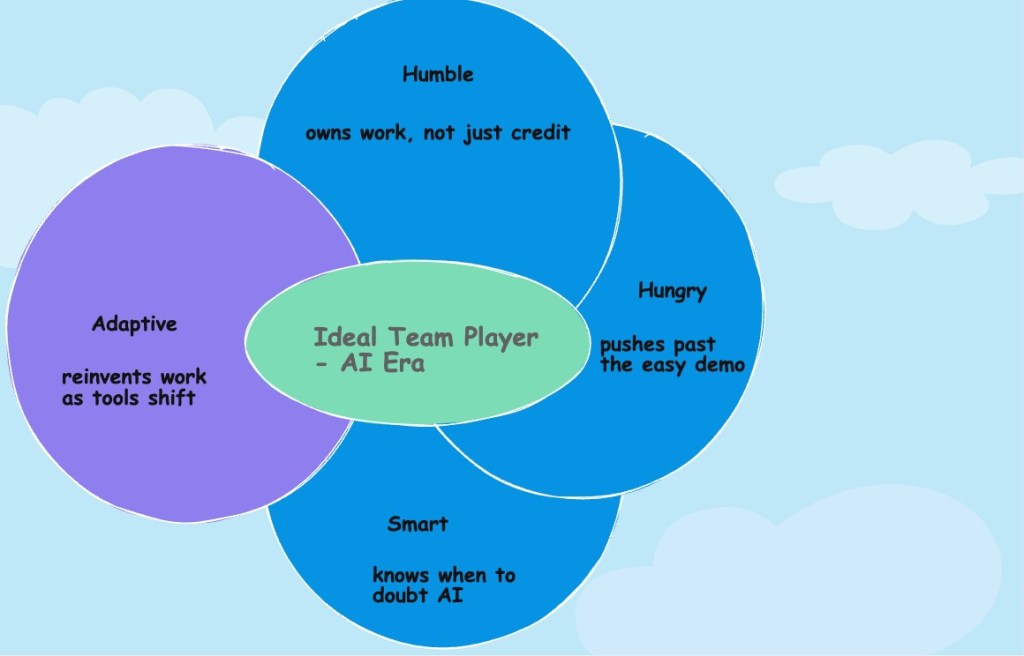
I put a specific question to the team: is adaptiveness really its own trait, or is it just a subset of being smart — people-smart, specifically, since adjusting to change often means reading how others around you are responding and calibrating accordingly?
I’m honestly not fully convinced either way. Lencioni’s version of smart is about social and emotional intelligence — reading a room, knowing how you land on people. Adapting to new tools or new ways of working feels like a different muscle. Someone can be sharply people-smart and still resist or fumble when the ground shifts under their process. So my instinct is that adaptiveness isn’t directly smartness, even if the two are correlated. But I said the same thing to the team and didn’t land on a clean answer, so I won’t pretend to have one here.
So I’ll leave you with the question we ended our session on: is adaptiveness a fourth, independent virtue — or is it just people-smarts applied to change? What do you think?


[…] “connection hour” at Checkr — the same low-tech, no-sprint-talk hour I described in the first article of this series — we picked that old post of mine as the topic. Partly out of curiosity: does a framework from […]
LikeLike