
Every other Friday, our engineering teams at Checkr step away from Jira tickets, incident responses, Claude AI prompts and roadmaps for an hour. We half-jokingly call it our “AI detox”—a connection hour where we debate leadership ideas and push past surface-level manager-speak.
Having previously tackled Patrick Lencioni’s The Ideal Team Player and The Five Dysfunctions of a Team, our fifth session brought us back to his work with The Motive. It’s a short book that poses a question most people skip: Not how do you lead, but why did you want to lead in the first place?
I opened by telling the team I’d rather listen than lecture. That turned out to be the right call. They pushed back on the book’s core premise harder than I expected—and made the conversation far better than the book itself.
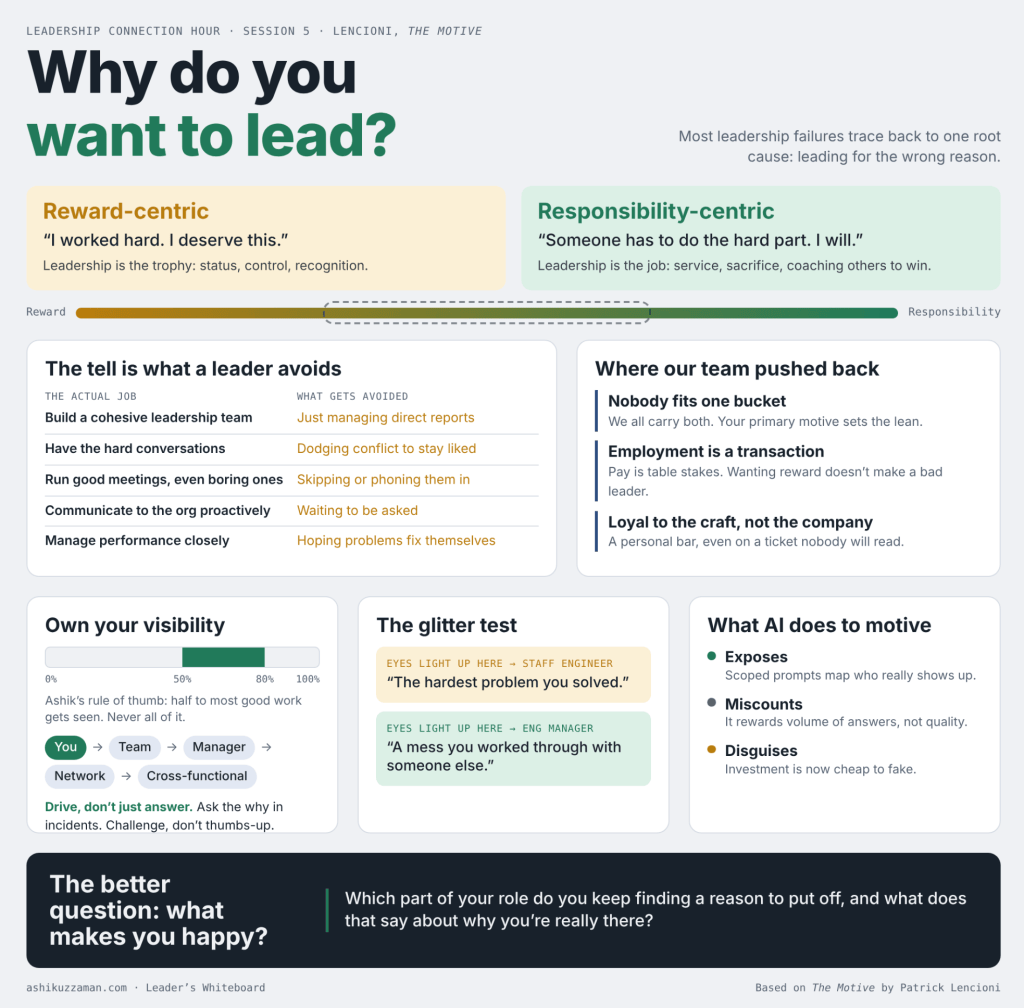
The Model: Two Primary Motivations
Lencioni uses the word “leader” broadly, but The Motive is primarily about people managers—the distinction being that manager is a title, while leader is a responsibility. With that caveat, he splits managers into two camps based on their underlying driver:
- Reward-Centric Leaders: View leadership as a prize for past performance. The title, authority, control, and recognition are the payoff for working hard.
- Responsibility-Centric Leaders: View leadership as a duty or sacrifice—essentially servant leadership. It’s about giving rather than getting, empowering others, and stepping up to do the uncomfortable work.
According to Lencioni, the real test isn’t what a leader says; it’s what they avoid. Reward-centric leaders tend to dodge five unglamorous duties: building a cohesive executive team, having difficult conversations, running productive meetings, communicating proactively, and closely managing performance.
Before we opened the floor, we agreed on one baseline: money is table stakes. Compensation doesn’t decide this binary. In tech, a strong individual contributor (IC) can earn as much as a manager. Control, influence, and high compensation are accessible without managing anyone.
The real question is: What actually satisfies you?
Do you light up when you crack a complex technical problem no one else could solve? Or do you light up when someone you coached cracks it? That second category of satisfaction is what Lencioni means by responsibility-centric leadership.
The Objections: Real-World Reality Checks
My team didn’t take Lencioni’s thesis at face value. Two major critiques emerged:
1. Nobody Fits Cleanly in One Bucket
The team pointed out that the model is too binary. Most effective leaders carry a mix of both drives: you want to unblock your team, but you also need personal rewards to stay motivated and keep momentum high.
The take: The buckets describe a center of gravity, not a rigid identity. What defines you is your primary pull. If prestige or authority drives you most, your center of gravity is reward-centric. If your team’s growth drives you most, it’s responsibility-centric.
2. Employment Is a Transaction
The sharper critique hit at Lencioni’s classic management-book assumption: that employees exist to serve the company. The reality is that employment is transactional. Wanting fair compensation or clear rewards doesn’t make someone a bad leader. Furthermore, younger generations (Millennials and Gen Z) are rightly explicit about boundaries, fair pay, and refusing to treat a corporation like a family.
The take: The best responsibility-centric leaders aren’t loyal to a corporate entity anyway—they are loyal to their craft and their people. Consider a minor detail like writing Jira tickets:
- Some write a one-line ticket because “nobody reads them.”
- Others write clear titles and three lines of context, even if they’ll never open the ticket again.
Why? Because their name is on it. It’s a personal standard of craft, independent of corporate praise.
The Paradoxes of Team Visibility
The debate then turned to a practical dilemma that management books rarely address: Can a responsibility-centric manager actually hurt their team’s career trajectory?
Consider two scenarios brought up by the team:
- The Risk of Being “Too Humble”: If a manager leads a team through a grueling, high-impact project and then quietly steps back saying “the work speaks for itself,” are they being humble? Or are they failing their responsibility to advocate for their people? A leader’s duty includes securing recognition for their team.
- The Reward-Centric Advantage for ICs: If you want to grow as an IC, aligning with a reward-centric manager can sometimes pay off faster. Reward-centric managers aggressively chase executive visibility, and that spotlight naturally shines on their team. Conversely, responsibility-centric managers may take principled, unpopular stands that cost them political favor—and their team absorbs that collateral damage.
We also discussed the workplace peer dynamic: working alongside a reward-centric colleague who acts as a “visibility black hole”—constantly dominating Slack channels just to stay seen—can be exhausting for everyone else.
Visibility Is Part of the Engineering Craft
I shared my own perspective on visibility with the team, as it’s something we navigate constantly: Doing the work and getting credit for it rarely map 1:1.
Any manager who tells you “Just do great work and the rest takes care of itself” is giving you a polished PR answer, not a realistic one.
If you want your impact to match your trajectory, you have to own your narrative:
- Package your work for your manager: Your manager is your primary amplifier, but they need clear inputs to advocate for you effectively upstream.
- Build a network beyond your team: When leadership hears the same manager praise the same engineer five times, they tune out. When a Product Manager or Staff Engineer from another org mentions your impact, it carries weight.
- Drive conversations, don’t just answer questions: During an incident response, answering questions shows technical skill. Steering the dialogue, asking “why,” and proposing systemic fixes shows leadership.
Deep technical competence is the engine—it’s the hardest part to build. But leadership outside your immediate circle often operates on a boolean: Did it get done or not? That’s why modern engineering rubrics evaluate impact beyond code.
The “Glitter Test” & How AI Is Changing the Game
This discussion brought to mind a interview heuristic I’ve relied on for years:
- When I ask a candidate a deep technical question, a strong engineer’s eyes light up. They see a puzzle they want to solve.
- When asking about navigating a messy human conflict, a different set of candidates lights up.
When hiring an Engineering Manager, I look for the sparkle during the human discussion—the moment they detail making a mistake, identifying a gap, relying on someone else’s strengths, and coaching them to succeed. If a manager candidate only lights up when describing a complex technical system they built alone, they may be a fantastic Staff Engineer, but not a manager.
How Generative AI Distorts the Motive
We closed the hour discussing AI’s impact on leader motives. While AI tools can map domain expertise across communication channels, they also introduce a new risk: AI makes fake engagement cheap.
A reward-centric individual can now use AI to generate thoughtful, detailed responses across Slack or pull requests with minimal personal effort—capturing visibility without genuine investment.
Because technical presence can be simulated, true leadership shifts to the un-fakeable moments:
- Navigating difficult, high-stakes conversations.
- Following through on complex post-mortems.
- Taking accountability when things go wrong.
Where We Landed
The real question isn’t whether you fit Lencioni’s neat binary. It’s simpler: What actually makes you happy at work?
Some engineers are happiest solving deep technical challenges and leaving the spotlight to others. Others want to manage quietly. Some explicitly opt out of the management track entirely—which isn’t a lack of ambition, but a healthy alignment of skills and desires.
For those of us who do choose to lead, two responsibilities are non-negotiable:
- Uncover and protect quiet high-performers who drive critical systems but will never self-promote.
- Advocate for your team proactively. Don’t wait for performance review cycles or organizational systems to force you to highlight your team’s wins.
Lencioni’s model may be overly simplified, but its core truth remains: Leadership is defined by unglamorous, difficult tasks—and your underlying motive dictates which of those tasks you quietly try to avoid.
Which brings me to the question I left with my team: Of all the responsibilities your current role requires, which one do you consistently find reasons to put off—and what does that reveal about why you’re really there?


