
From a summit stage to our Friday hour
A week earlier, I attended Checkr’s three-day Leadership Summit at the Omni Hotel in San Francisco, alongside fellow Engineering Managers, Staff Engineers, Product Managers and other leaders from across the organization. Brooks led the first morning session and introduced us to the Dreaded Drama Triangle (DDT) and its antidote, The Empowerment Dynamic (TED), from David Emerald’s book The Power of TED.
I liked it so much that I made it the very next topic for Checkr’s bi-weekly Connection Hour that I host. So on Friday, October 23, some of us spent Session 6 discussing and debating the model, and, true to form, poking holes in it.
The problem: the Dreaded Drama Triangle
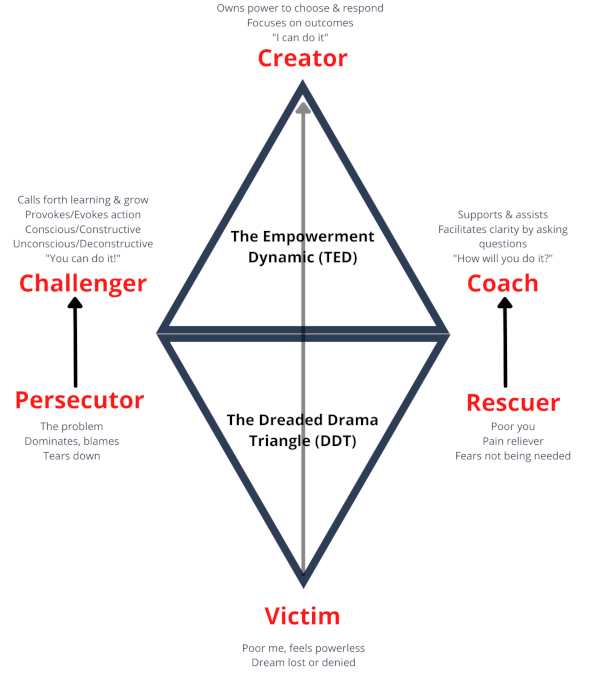
Psychiatrist Dr. Stephen Karpman described the Drama Triangle in 1968, after noticing three roles his patients kept falling into. David Emerald later added “Dreaded” to the name, and it stuck. The three roles feed each other, which is why the pattern is so hard to leave.
- Victim: “Poor me.” The Victim feels powerless and believes their dream was lost or denied. The problem is often real. What goes wrong is the focus: all the energy goes to the problem, none to what could change it.
- Persecutor: “It’s your fault.” The Persecutor dominates, blames and tears people down. Often this is a way to avoid feeling like a victim yourself. If someone else is the problem, I don’t have to be.
- Rescuer: “Poor you.” The Rescuer relieves the pain and quietly fears not being needed. Rescuing feels kind, but it confirms the Victim’s helplessness instead of building their capability.
The last point is the one that landed hardest in the room. A Rescuer catches the fish for you. That feels great today, and it guarantees you will need them again tomorrow. The triangle survives because every role gets something out of it: the Victim gets sympathy, the Persecutor gets to be right, and the Rescuer gets to be needed. Nobody gets better.
Where the triangle hides in engineering teams
The team didn’t just accept the model. They pushed on it, and the pushback was the best part of the hour.
Rescuers outnumber Victims in tech. One observation surprised me. Engineers rarely sit in “poor me” for long. We are far more likely to be Rescuers. We jump in, patch it, ship the fix at midnight, and call it ownership. Sometimes that “help” even looks like innovation. But if the same person keeps needing the same rescue, we have built a dependency, not a team.
Rescuers can manufacture Victims. A leader who wants to be needed can frame a capable team as overwhelmed, then step in to save them. It works the other way too. A reward-centric leader can manufacture a problem, then rescue the situation and collect the credit. We talked about a “system score” example: a skilled persuader can frame a 70 out of 100 as failing to justify an intervention, even when 70 is good enough. Every point past a healthy threshold costs more than the last. The antidote is data: measure input against output, and pick the battles worth fighting.
The model can be weaponized. A Persecutor can tell a Creator “you’re just playing the victim” to dodge their own accountability. Any shared vocabulary can become a club if people use it on each other instead of on the situation.
Scope fights are triangle fights. Picture any team handed work that sits outside its charter. The first reaction was pure Victim: this isn’t ours, why us? A Creator response would have been different. Get explicit agreement that the work is out of scope, then treat whatever gets delivered as a bonus rather than a burden.
Is it even a triangle? One teammate questioned the shape itself. The roles may not interact like equal peers; it can feel more upstream and downstream. Another pointed out the roles blur. Persecutor and Rescuer can swap within one conversation. Victim versus Creator is usually the clearest line.
The solution: The Empowerment Dynamic (TED)
In 2009, David Emerald proposed The Empowerment Dynamic, or TED, as the way out. Karpman himself wrote the foreword, endorsing it as the answer to his own triangle. TED keeps the three positions but flips the orientation of each one, from problem-focused to outcome-focused.
| Drama role (DDT) | Says | Empowered role (TED) | Says |
|---|---|---|---|
| Victim | “Poor me.” | Creator | “I can do it.” |
| Persecutor | “It’s your fault.” | Challenger | “You can do it!” |
| Rescuer | “Poor you.” | Coach | “How will you do it?” |
- Creator. Acknowledges the problem, then owns the power to choose a response. The question changes from “why is this happening to me?” to “what do I want, and what is in my control?”
- Challenger. Still holds a high bar, but aims it at growth instead of blame. Not “who broke this?” but “what can we do better next time?” A good postmortem is a Challenger at work.
- Coach. Still cares, but asks instead of fixes. The Coach helps people get clear on their own path, which means they can walk it again without you.
Notice that nobody in TED pretends the problem isn’t there. The Creator still has the outage. The Challenger still calls out the gap. The Coach still shows up. What changes is where the energy goes.
The key move: from Victim to Creator
The shift that matters most sits at the center: Victim to Creator. Once one person owns their response, the other roles lose their fuel. A Persecutor has nobody to blame, so they can become a Challenger. A Rescuer has nobody to save, so they can become a Coach.
The team added an honest caveat. One Creator surrounded by Rescuers and Persecutors will get pulled back into the triangle. The system tends to reset. That is why I see this as a team habit, not a solo act, and why a shared vocabulary helps so much.
Shorten the stay, don’t ban the visit. My own take: feeling like a victim is a natural reflex. Everyone gets there after a bad incident, a surprise reorg or a rejected proposal. The goal is not to never feel it. The goal is to shorten how long you stay. An hour of “this is unfair” is human. A month of it is a pattern.
When I catch myself there, I ask two questions. What is actually in my control? And what is possible inside the constraints I can’t change?
From “poor you” to “How will you do it?” For leaders, the hardest shift is often Rescuer to Coach. When a teammate brings a problem, our instinct is to solve it. Try asking instead:
- What outcome do you want here?
- What have you tried so far?
- What is one step you could take today?
- What do you need from me?
That last question still offers help. It just lets them stay the owner.
When the pattern repeats. A one-off disagreement about scope is healthy. Repeated refusal of the same kind of work is a different signal. It usually points to a mismatch between the role and the person, and that deserves a direct conversation, not another rescue.
A shared language, not a rulebook
No model is the truth, and DDT and TED are no exception. Their real value is giving a diverse team a common reference point. When we disagree, we can argue against the model instead of against each other. “I think I’m rescuing here” is much easier to say than “I think you’re making yourself helpless.”
Culture also follows leadership. If the people at the top keep running the triangle, the rest of the organization learns to play their parts. So if your team is already operating in TED, ask yourself a harder question: what is your role as the leader? My answer is to be the Challenger who sets the bar and the Coach who asks good questions. Not the Rescuer who needs to be needed.
Here are the three questions we used to prepare for the session. Try them on yourself this week:
- Which drama role do you fall into most often at work, and what pulls you into it?
- Think of a recent incident, escalation or cross-team disagreement. Where did the triangle show up?
- What is one way to move from “poor you” to “How will you do it?” with a teammate this week?
The drama will come back. It always does. The goal is to notice it sooner and step out faster.


